
CQC Care Agencies – Why Accreditation Matters


Most families in Abingdon worry about finding trustworthy home care for elderly relatives, especially when dementia or physical disabilities are involved. Choosing a British care agency that is accredited by the Care Quality Commission is vital because CQC regulates over 25,000 care providers across England. This guide will help clear up common misconceptions, show what makes an agency truly compassionate, and support your search for safe and reliable care.
Table of Contents
Key Takeaways
Point | Details |
Understanding CQC Registration | All organisations delivering regulated care must register, regardless of size, ensuring high standards in care. |
CQC’s Regulatory Scope | The CQC not only inspects services but also collaborates with partners to promote continuous improvement in care quality. |
Rating System Importance | CQC’s ratings provide clarity on service quality, helping families make informed choices about care providers. |
Legal Duties of Care Providers | Accredited care providers must comply with stringent legal obligations, including transparency and documentation related to incidents in care. |
CQC care agencies and common misconceptions
Understanding the Care Quality Commission (CQC) is essential for families seeking reliable home care services. The CQC plays a critical role in regulating health and adult social care across England, ensuring providers maintain high standards of safety, effectiveness, and compassionate care. Despite its importance, many people hold misconceptions about what the CQC actually does and how it operates.
One prevalent misconception is that CQC registration applies only to large care providers. In reality, any organisation delivering regulated care activities must be registered, regardless of size. This includes both private and NHS providers across various care settings. The CQC’s comprehensive approach means they inspect services using tailored methods, publishing detailed ratings that help families make informed decisions about care providers.
Another common misunderstanding is the scope of CQC’s regulatory work. The commission does far more than simply checking boxes. They work closely with NHS England and other partners to share intelligence, manage potential risks early, and actively encourage continuous improvement in care services. Their inspections assess multiple dimensions of care, including safety, effectiveness, responsiveness, caring approach, and leadership quality.
Professional Insight: When evaluating a care agency, always verify their current CQC rating and review their latest inspection report to understand their true quality of service.
Types of care regulated by CQC
The Care Quality Commission (CQC) plays a vital role in maintaining high-quality healthcare standards across England by regulating a comprehensive range of health and social care services. The commission oversees eight core service types, ensuring that providers meet fundamental standards of safety, effectiveness, and compassionate care.
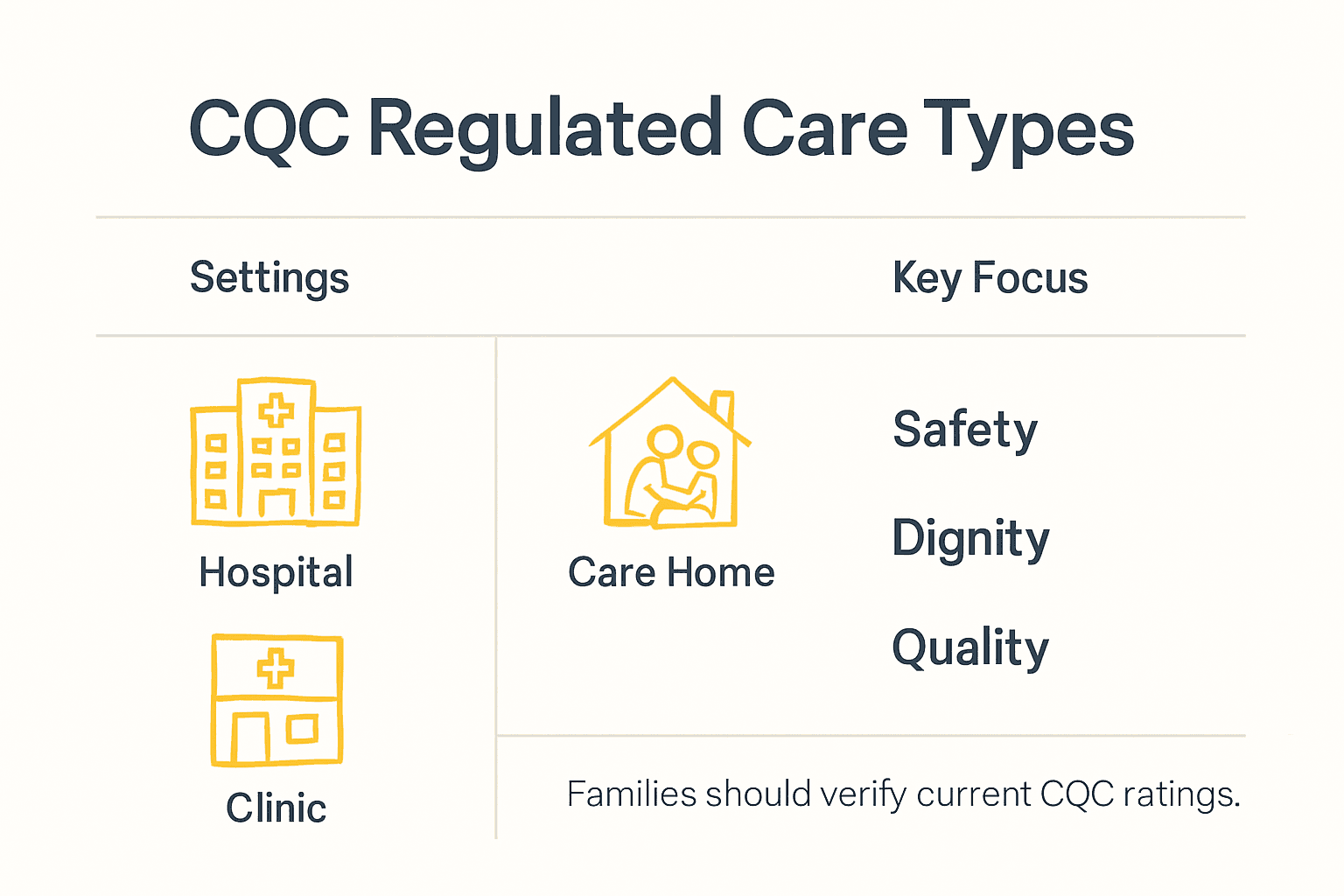
These regulated services encompass a broad spectrum of healthcare environments. CQC monitors hospitals, care homes, community services, dental services, and mental health services, ensuring that all providers comply with the Health and Social Care Act 2008 regulations. The core service types include urgent and emergency services, medical care for older people, surgery, critical care, maternity and gynaecology services, paediatric care, end of life care, and outpatient and diagnostic imaging services.
Beyond traditional healthcare settings, the CQC has expanded its regulatory scope to include emerging healthcare technologies. This comprehensive approach means that digital health solutions, telehealth services, and innovative care pathways are also subject to rigorous assessment. Each service is meticulously inspected and rated across five key dimensions: safety, effectiveness, caring approach, responsiveness, and leadership quality.
Professional Insight: When choosing a care provider, always request their most recent CQC inspection report to understand their performance across these critical care dimensions.
Here’s an overview of CQC-regulated care service types and their main focus:
Care Service Type | Primary Focus | Example Provider |
Urgent & Emergency Care | Immediate medical response | NHS A&E Department |
Medical Care for Older People | Age-related health needs | Residential Care Home |
Surgery | Operative procedures | Surgical Centre |
Critical Care | Intensive, life-support | ICU Unit |
Maternity & Gynaecology | Pregnancy, childbirth | Maternity Hospital |
Paediatric Care | Child healthcare | Children’s Hospital |
End of Life Care | Palliative support | Hospice Service |
Outpatient & Diagnostics | General investigations | Diagnostics Clinic |
Key standards and rating system explained
The Care Quality Commission (CQC) has developed a comprehensive and nuanced approach to evaluating healthcare services, focusing on five fundamental questions that assess the core dimensions of care quality. These critical questions examine whether services are safe, effective, caring, responsive to people’s needs, and well-led, providing a holistic view of healthcare provision beyond simple compliance checks.

The CQC’s rating system employs a four-point scale that offers transparent and detailed insights into service performance. The ratings range from Outstanding (the highest accolade) to Good, Requires Improvement, and Inadequate. This nuanced approach allows families and commissioners to quickly understand the quality and safety levels of different care providers. Inspectors gather evidence through multiple channels, including announced and unannounced visits, staff interviews, patient feedback, and comprehensive documentation reviews.
Each rating represents a detailed assessment of the service’s performance across multiple dimensions. An Outstanding rating indicates exceptional care that consistently goes above and beyond standard expectations. Good ratings signify a reliable, competent service meeting all fundamental standards. Services rated as Requires Improvement have identified areas for development, while Inadequate ratings signal significant concerns that demand immediate intervention and remedial action.
Professional Insight: When reviewing a care provider’s CQC report, pay close attention to the specific comments and recommendations, not just the overall rating, to gain a comprehensive understanding of their service quality.
Here’s a summary of the CQC rating levels and what each means for families:
Rating Level | Meaning for Families | Action if Seen |
Outstanding | Exceptional, continuously above standards | Strongly recommended choice |
Good | Meets all fundamental standards | Reliable and trustworthy |
Requires Improvement | Areas needing targeted development | Review report details |
Inadequate | Significant concerns, urgent change needed | Avoid or seek alternatives |
Legal duties of accredited care providers
Registered care providers have comprehensive legal obligations outlined in the Health and Social Care Act 2008. These legal requirements mandate that all providers carrying out regulated activities must register with the Care Quality Commission and maintain rigorous standards of care. The fundamental legal duties encompass ensuring service safety, effectiveness, compassion, responsiveness, and demonstrating strong leadership across all care delivery aspects.
One of the most critical legal responsibilities is the statutory duty of candour. This requirement compels care providers to maintain absolute transparency when incidents occur during care delivery. Providers must promptly inform patients or their relatives about any ‘notifiable safety incidents’, offer a sincere apology, and provide comprehensive information regarding investigations and potential outcomes. Failure to comply with this duty can result in significant consequences, including financial penalties or potential deregistration.
Beyond the duty of candour, accredited care providers must continuously monitor and report potential risks, maintain comprehensive documentation, and demonstrate ongoing compliance with regulatory standards. This means implementing robust systems for incident reporting, staff training, risk management, and maintaining the highest standards of professional conduct. The legal framework is designed to protect vulnerable individuals and ensure that care services consistently meet the essential benchmarks of quality and safety.
Professional Insight: Always request a provider’s most recent compliance documentation and ask specific questions about their risk management and incident reporting processes to understand their commitment to legal and ethical care standards.
Costs, contract terms and alternatives
Social care charges in the United Kingdom exhibit significant variation based on care type and individual requirements. Home care services typically range from £22 to £33 per hour, with residential and nursing care weekly costs spanning from £804 to over £1,000. These prices fluctuate depending on specific care needs, such as specialised dementia support or complex nursing requirements, making it crucial for families to understand the detailed cost breakdown.
The NHS Standard Contract provides a comprehensive framework for healthcare service commissioning, establishing clear guidelines for care agencies. This critical document outlines precise terms regarding compliance, quality standards, safety requirements, and operational protocols. The contract ensures transparency in financial arrangements, specifies performance monitoring mechanisms, and establishes robust dispute resolution procedures, giving families and commissioners a structured approach to understanding care service provisions.
Beyond standard care packages, families have several alternative options to manage care costs. Local council funding, means-tested support, direct payment schemes, and private insurance can provide financial relief. Some individuals might qualify for partial or full funding depending on their financial circumstances and care needs. Additionally, some care agencies offer flexible payment plans, sliding scale fees, or packaged care options that can help make professional care more accessible.
Professional Insight: Always request a detailed, itemised quote that breaks down all potential charges, including any additional fees for specialised services or extra support requirements.
Choose Accredited Care That Truly Makes a Difference
Navigating the complex world of home care can be overwhelming, especially when ensuring that your loved ones receive safe, effective, and compassionate support from a CQC-registered provider. The challenge lies in finding a care agency that not only meets but exceeds the demanding standards of the Care Quality Commission’s rating system, ensuring transparency, legal compliance, and personalised care tailored to those living with dementia, Parkinson’s, or physical disabilities.
At Chamomile Care, we understand these crucial requirements and have proudly maintained an Outstanding CQC rating, reflecting over 40 years of experience delivering exceptional home care in Abingdon. Our team’s dedication to upholding legal duties, embracing continuous staff training, and practicing the statutory duty of candour ensures your peace of mind and your family’s wellbeing. Learn more about our compassionate care services, including medication management and personal care, by visiting Chamomile Care.
Discover the difference of trusted accreditation and personalised care now.
Are you ready to explore outstanding home care that puts your family first?
Start your journey with Chamomile Care today by visiting our website to understand our proven care process, browse testimonials, and connect with our team. Experience home care where quality, compassion, and transparency come together for those who matter most.
Frequently Asked Questions
What is the role of the Care Quality Commission (CQC) in regulating care agencies?
The CQC is responsible for ensuring that health and adult social care providers meet high standards of safety, effectiveness, and compassionate care. They regulate all organisations delivering regulated care activities, irrespective of size, and conduct inspections to assess service quality.
Why is CQC accreditation important for care agencies?
CQC accreditation indicates that a care agency adheres to the required legal standards and provides a quality service. Families can trust agencies with CQC accreditation as it reflects ongoing compliance with safety and care benchmarks, ensuring better outcomes for individuals receiving care.
How can I find a care agency’s CQC rating?
You can check a care agency’s current CQC rating and inspection report on the CQC’s official website. This resource provides detailed insights into their performance across various quality dimensions, helping families make informed decisions.
What does the CQC inspection process involve?
The CQC inspection process includes announced and unannounced visits, staff interviews, patient feedback, and documentation reviews. Inspectors assess multiple dimensions of care quality such as safety, effectiveness, and leadership to determine the agency’s overall rating.
Recommended
Comments